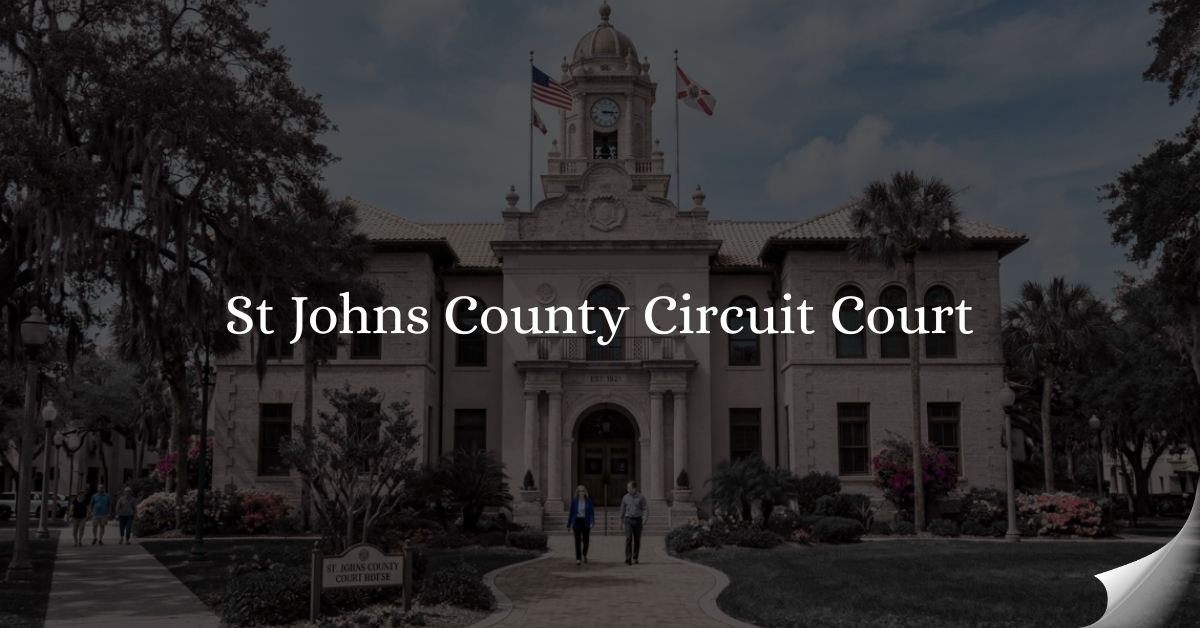
St Johns County Circuit Court operates as a key trial-level court within the Florida judicial system. It sits under the 7th Judicial Circuit and handles serious legal matters that require formal hearings and judicial decisions. This court plays a central role in managing cases that go beyond county court authority. It deals with disputes where evidence is reviewed, arguments are heard, and rulings are issued by assigned judges. Within St Johns County Circuit Court Information, it stands as a structured legal body focused on fair case handling and lawful resolution across the county.
The court covers a broad range of services tied to major case categories. Civil cases involve property issues, contracts, and financial disputes between parties. Criminal cases focus on felony offenses that require higher court review and sentencing authority. Family law matters include divorce, custody arrangements, and child support rulings. It also handles limited appeals from lower courts when review is needed. Through these services, St Johns County Circuit Court maintains case processing, supports legal decision-making, and provides formal rulings across different areas of law in St Johns County.
How to Search St Johns County Circuit Court Records Online
St Johns County court records lookup helps users check case details through the official court system. The court docket search system provides structured case information for civil, criminal, and family matters filed in St Johns County process of reviewing records relies on the Florida judicial docket information system, which organizes cases by number, party name, and filing type. Users can perform a case number search Florida system or use name-based search methods to locate specific files and case status details.
How to Search Circuit Records
- Open Official Website: https://stjohnsclerk.com
- Scroll Down on Homepage
- Find “Online Services” Section
- Click the Required Option
- Select “Court Records Search”
- Choose Search Type
- Enter Details
How Case Numbers Differ from Search Types
Case numbers provide exact matching results, which makes them more precise. Name-based search covers broader results and may include multiple cases.
| Search Type | Strength | Limitation |
|---|---|---|
| Case number search Florida | High accuracy | Requires full number |
| Name-based search | Flexible | May show multiple records |
Civil vs Criminal Record Search Differences
Civil and criminal records follow different processing systems inside the court docket search system.
Civil records include:
- Property disputes
- Contract issues
- Monetary claims
- Business litigation
Criminal records include:
- Felony charges
- Misdemeanor cases
- Arrest-related filings
- Sentencing records
Civil cases often focus on disputes between parties. Criminal cases involve state prosecution through Florida judicial courts.
Public Record Limits in Florida
Not all case data appears in online systems. Some records remain restricted under Florida court rules. Some documents may show only partial details such as docket entries without full filings. Court clerks may restrict sensitive data to protect privacy and legal compliance.
Limitations include:
- Sealed family law cases
- Juvenile records
- Certain sensitive criminal investigations
- Expunged case files
What is St Johns County Circuit Court?
St Johns County Circuit Court is a trial-level court in Florida that handles serious legal matters such as felony crimes, major civil disputes, and family law cases. It serves as part of the Florida judicial system and operates within the 7th Judicial Circuit. This court holds broad authority under state law and manages cases that go beyond the limits of lower courts in St Johns County Florida. The circuit court in St Johns County Florida is the highest trial court within the county’s judicial division. It hears cases that require formal trials, legal arguments, and final judgments issued by a judge. This court is part of the state judicial system structure and follows Florida statutes for all proceedings. Judges in this court handle both jury and non-jury trials depending on case type.
Role in Florida Judicial System
Within the Florida judicial system, circuit courts act as primary trial courts for major legal matters. This structure ensures that serious legal issues are reviewed at a higher judicial level with formal procedures and legal oversight.
The St Johns County Circuit Court manages:
- Felony criminal cases
- High-value civil disputes
- Family law matters such as custody and divorce
- Appeals from county court decisions
Difference Between Circuit Court and County Court
The circuit court and county court serve different roles in St Johns County judicial division. The circuit court has wider circuit court authority and deals with more complex and serious cases compared to county court.
| Circuit Court | County Court |
|---|---|
| Handles felony cases | Handles misdemeanors |
| Covers large civil disputes | Covers small claims |
| Family law cases included | Limited family-related matters |
| Appeals from county court | First-level minor cases |
Jurisdiction Scope of St Johns County Circuit Court
This jurisdiction ensures that significant legal disputes are resolved under structured trial-level court Florida procedures. The jurisdiction St Johns County court system gives circuit courts authority over:
- All felony criminal offenses
- Civil cases involving higher monetary value
- Family law proceedings
- Probate and estate matters
- Appeals from lower courts
Jurisdiction of St Johns County Circuit Court
St Johns County Circuit Court holds legal authority over major cases within the county’s judicial structure. Its court jurisdiction St Johns County covers serious criminal matters, high-value civil disputes, and limited appellate review from lower courts. The Clerk of Courts supports administrative operations by managing filings, maintaining official records, and assisting with case documentation across divisions. This felony court Florida circuit court operates as a trial-level authority where evidence is examined, hearings are conducted, and final judgments are issued under Florida law.
Criminal Jurisdiction
The circuit court functions as the main felony court Florida circuit court for serious criminal offenses. It handles cases that involve severe penalties under state statutes and cannot be processed in county court. These matters often include violent crimes, drug trafficking cases, burglary, and other felony-level violations. In criminal jurisdiction, the court conducts formal trials where both sides present evidence and witnesses. Judges or juries evaluate the facts and apply Florida criminal law to reach a final decision. Because these cases involve higher stakes and longer sentences, they remain exclusively under circuit court authority within St Johns County.
Civil Jurisdiction
The civil division court cases handled by the circuit court involve disputes that exceed the monetary limits of county court. These civil matters often include contract disagreements, property conflicts, business litigation, and financial damage claims. In civil jurisdiction, the court reviews legal filings, hears arguments, and examines evidence to determine liability or compensation. The court’s role becomes important when disputes involve significant financial value or complex legal questions that require formal trial procedures.
Appellate Authority
The circuit court also holds limited appellate authority within the St Johns County judicial system. It reviews decisions made by county courts when a party challenges the outcome of a case. These appeals do not involve new trials. Instead, judges review records, legal arguments, and procedures followed in the original case. This appellate function ensures that legal standards are correctly applied and that lower court decisions follow Florida law. It acts as an additional layer of review within the state judicial system structure.
Limits of Jurisdiction
Although the St Johns County Circuit Court has broad authority, its jurisdiction is defined by state law. It does not handle federal cases, which fall under federal courts. It also does not manage minor civil disputes that remain within county court limits. Some sensitive matters, such as certain juvenile records or sealed cases, are restricted from public access. These limitations maintain clear separation between different court levels in Florida’s judicial system.
Court Divisions in St Johns County Circuit Court
St Johns County Circuit Court is divided into specialized sections that manage different categories of legal matters. Each division follows distinct procedures under Florida judicial rules, which helps keep case handling structured and efficient across criminal, civil, family, and appellate matters.
Criminal Division
The Criminal Division serves as the felony court Florida system within St Johns County Circuit Court. It deals with serious criminal offenses that fall under state felony law and require formal trial procedures. This division manages cases that begin with arrest and formal charges filed by the state. The process includes arraignment, hearings, plea discussions, and trial stages where evidence is reviewed in detail.
Key case types handled in this division include:
- Violent criminal offenses such as assault and robbery
- Drug trafficking and controlled substance violations
- Burglary and property-related felony crimes
- Fraud and financial crime cases
- Weapons-related felony charges
Civil Division
The Civil Division manages civil cases Florida circuit court jurisdiction involving disputes between individuals, businesses, or organizations. These cases focus on legal rights, property issues, and financial claims rather than criminal penalties. Typical matters include contract disagreements, real estate disputes, business conflicts, and injury-related claims that exceed county court limits. The division ensures that complex legal disputes are resolved through structured court procedures. The civil workflow begins with filing a complaint, followed by responses from the opposing party. Both sides then present evidence through discovery and pre-trial motions before proceeding to trial if no settlement is reached. Final decisions may involve compensation, enforcement orders, or dismissal depending on case findings.
Family Division
The Family Division handles family law cases St Johns County residents bring related to domestic and household matters. These cases often involve sensitive issues where legal decisions impact family structure and child welfare.
Key case types handled in this division include:
- Divorce and legal separation matters
- Child custody and visitation disputes
- Child support determination and modifications
- Adoption and guardianship cases
- Domestic relations cases involving protection orders
Appellate Division
The Appellate Division reviews decisions from lower courts within St Johns County Circuit Court jurisdiction. It handles appeals Florida circuit court cases where parties challenge legal rulings made in county court. This process focuses on reviewing case records rather than hearing new evidence. Judges examine transcripts, legal arguments, and procedural history to determine whether errors occurred during the original case.
Court Records & Public Access Rules
St Johns County Circuit Court records are part of Florida’s public records court access system, which allows the public to review many legal documents and case details. This system supports Florida court transparency while still protecting sensitive information under state law. Court records may include case filings, docket entries, hearing dates, and final judgments depending on the case type. However, access is not unlimited, and certain records remain restricted based on legal confidentiality rules.
What is Publicly Available
Most standard court records in St Johns County are open to public viewing through the clerk’s records system. These records are part of Florida’s commitment to open government and judicial transparency. These records are typically available for civil, criminal, and family law matters unless sealed by court order. The public can review them through official court search portals managed by the clerk’s office.
Common publicly available information includes:
- Case numbers and filing dates
- Party names involved in cases
- Court docket entries and hearing schedules
- Final judgments and orders
- Case status updates
What is Restricted or Confidential
Not all court information is open to public access. Some records are protected under records confidentiality rules to maintain privacy and legal security. Sealed cases are fully hidden from public view by court order. Expunged records are removed from public databases entirely. These restrictions are applied under Florida law to protect individuals involved in sensitive legal situations.
Restricted information may include:
- Juvenile court records
- Sealed or expunged cases
- Certain domestic violence protection details
- Sensitive financial disclosures in family law cases
- Ongoing investigations in specific criminal matters
Legal Access Guidelines
Access to court records in Florida follows structured legal rules designed to balance transparency and privacy. The clerk’s office controls record availability and follows state statutes when releasing information. Florida’s public records system is based on the principle of open access, but it also protects confidential case material when required by law. This balance allows citizens to review court activity while maintaining privacy protections where necessary.
Users accessing public records must follow these legal conditions:
- Records must be used for lawful purposes only
- Misuse of personal data from court records is prohibited
- Some documents may require formal request procedures
- Certified copies may involve processing fees
Difference Between Circuit Court and County Court
St Johns County follows Florida’s court structure Florida system, where cases are divided between circuit courts and county courts based on severity and legal complexity. The comparison of circuit court vs county court Florida shows clear differences in authority, case types, and jurisdiction levels. Both courts operate as trial courts, but they handle different levels of legal matters within the state judicial system.
Structural Comparison
Circuit courts sit at a higher level in the local court structure and handle more serious matters. County courts operate as lower courts and manage less complex cases. Circuit courts have broader judicial authority, while county courts focus on limited jurisdiction cases. Both work together to ensure legal matters are processed based on severity and legal scope.
Case Type Differences
The division of cases between these courts depends on the type and seriousness of the legal matter. Circuit court cases typically include felony criminal offenses, major civil disputes, family law matters, and appellate reviews. These cases often involve detailed hearings and formal trial procedures. County court cases usually involve misdemeanors, traffic violations, small claims, and lower-value civil disputes. These cases are processed faster due to their simpler nature and limited legal complexity.
Authority Hierarchy
In Florida’s judicial system, circuit courts hold higher authority than county courts within the trial court structure. Circuit courts can review appeals from county court decisions in certain situations, which places them above county courts in the jurisdiction levels system. County courts cannot review circuit court rulings. This hierarchy ensures that more serious cases are handled with greater judicial authority, while minor cases are resolved at the county level.
How to Access Court Services in St Johns County
St Johns County court services are available through both online systems and in-person support at the Clerk of Court office. These services provide clerk of court records access for case searches, filings, payments, and public record requests. Residents can choose the method that best fits their needs depending on the type of information required.
Online Access to Court Services
Most court-related services are available through the official St Johns County Clerk website. The online system allows users to search case records, review docket information, and check case status without visiting the office. This digital system is the fastest way to review public case details and track ongoing court matters.
Through online court services, users can:
- Search civil, criminal, and family case records
- View docket updates and hearing schedules
- Request official record copies
- Check payment and fine information
In-Person Records Request
For those who prefer direct assistance, in-person records request services are available at the Clerk of Court office in St Johns County. Staff assist with locating case files, providing certified copies, and processing formal record requests. Visitors may need case numbers or party names to speed up the search process. Some certified documents may require identification and processing fees depending on request type.
Frequently Asked Questions
St Johns County Circuit Court records and procedures often raise common questions among users searching for case details, legal status, and court processes. These FAQs provide clear answers about St Johns County court records lookup, public access rules, case types, and how the court system operates within Florida’s judicial structure. The information below helps explain both online and in-person court services in a simple and direct way.
How do I find St Johns County Circuit Court records?
St Johns County Circuit Court records can be found through the Clerk of Court’s official records search system. Users can perform a St Johns County court records lookup using a case number or party name. The system shows docket entries, case filings, and status updates for civil, criminal, and family matters.
What cases are handled in circuit court?
The circuit court handles serious legal matters such as felony criminal cases, high-value civil disputes, family law cases, and selected appeals. It operates as a trial-level court Florida system for complex cases that require formal hearings and judicial decisions.
Can I search court records by name?
Yes, court records can be searched using a name-based search option. Users enter the first and last name of a party, and the system displays matching results. This method is helpful when a case number is not available, although multiple records may appear for common names.
Are Florida court records public?
Many Florida court records are part of public records court access laws. This means most case information, such as filings, docket entries, and judgments, is available to the public. However, sealed cases, juvenile records, and certain sensitive information remain restricted under confidentiality rules.
How do I check case status online?
Case status lookup online is available through the Clerk of Court portal. After entering a case number or name, users can view updates such as active status, scheduled hearings, and final rulings. The system is part of the official docket information system used in St Johns County.
What is a circuit court docket?
A circuit court docket is a record of all activities and updates related to a case. It includes filings, motions, hearings, and court decisions. The docket information system provides a timeline of how a case progresses through the court process.